
Glass insulators suit lines that need long, predictable service life and easy visual inspection. Composite insulators suit lines that need low weight, compact structures, or strong performance in polluted areas. This guide compares both types on the points that decide a purchase, then gives a clear selection rule.
Need a quote for either type? Request a datasheet and quotation — our engineers reply with a matched specification for your voltage and pollution level.
What is the core difference between glass and composite insulators?
Glass insulators use a toughened glass shell cemented to a metal cap and pin. Composite insulators use a fiberglass-reinforced (FRP) core rod, covered with silicone rubber sheds and fitted with crimped metal end fittings. The materials decide almost every difference in weight, pollution behavior, failure mode and inspection method.
Glass insulator (toughened glass disc)
- Structure: Toughened glass dielectric, galvanized steel cap, steel pin, cement joint.
- Assembly: Discs are linked into a string. Voltage class is set by the number of discs.
- Rating: Each disc is named by its failing load, for example U120B (120 kN) or U210B (210 kN).
- Typical standards: IEC 60383-1 (components) and IEC 60383-2 (strings and sets). See our toughened glass insulator IEC certification page for test details.
Composite insulator (polymer insulator)
- Structure: FRP core rod carries the mechanical load. Silicone rubber housing gives the electrical insulation and creepage distance. Metal end fittings are crimped onto the rod.
- Assembly: One continuous unit per string, so no disc count.
- Typical standards: IEC 61109 (composite suspension and tension insulators) and IEC 62217 (general definitions and test methods for polymeric insulators). See our composite insulator manufacturer page for our production range.
How do glass and composite insulators compare side by side?
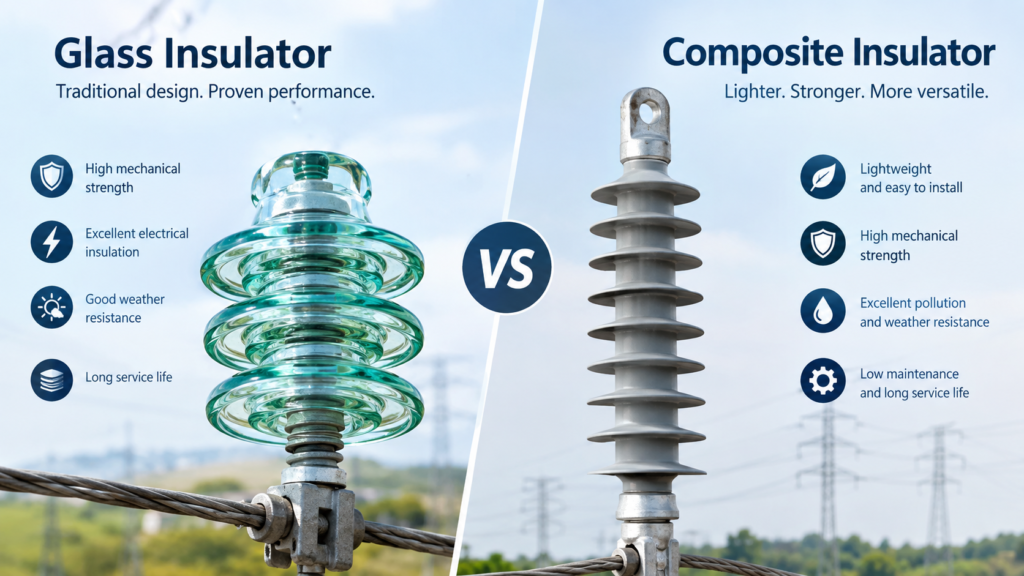
Composite insulators win on weight and pollution performance. Glass insulators win on ageing stability and inspection. The table summarizes typical behavior; exact values depend on design and manufacturer.
| Factor | Glass insulator | Composite insulator |
|---|---|---|
| Weight | Heavy; string weight rises with voltage | Much lighter, commonly a fraction of an equivalent glass string |
| Mechanical failure mode | Glass shatters when defective; the cap and pin usually keep holding the line | FRP core can fail without visible warning if damaged internally |
| Fault detection | Visual, from the ground or by drone; a shattered disc is obvious | Needs visual checks, infrared, or specialized tools; internal defects are hard to see |
| Ageing | Glass does not age; stable dielectric and strength over time | Silicone rubber can lose hydrophobicity, track, or erode over time |
| Pollution performance | Relies on creepage distance and cleaning or washing | Silicone rubber sheds water and can transfer hydrophobicity to pollution layers |
| Design flexibility | Fixed by disc profile and count | Long creepage distance in a compact, custom length |
| Handling and installation | Heavier, more labor and crane time | Easy to lift and install; needs care to avoid bending and impact on sheds |
| Vandalism (gunshot, stones) | Disc shatters, string often stays up | Sheds can be damaged; core usually survives unless hit directly |
| Standard service life expectation | Commonly 40+ years in service | Commonly 25–40 years, depending on quality and environment |
Which type performs better in polluted or coastal areas?
Composite insulators generally perform better in heavy pollution, coastal and desert areas. The silicone rubber surface is hydrophobic, so water beads up instead of forming a conductive film. This reduces leakage current and flashover risk on contaminated surfaces.
Glass insulators can still work in polluted areas if you choose a fog-type (anti-pollution) disc with a longer creepage distance. This raises string cost and weight, and often means periodic washing. IEC/TS 60815 gives the method for selecting insulators by site pollution severity (parts 1 to 3 cover general rules, ceramic and glass, and polymer).
Rule of thumb: Heavy pollution with limited maintenance access points to composite. Moderate pollution with regular line inspection works well with either.
Which type is easier to inspect and maintain?
Glass is easier to inspect. A defective toughened glass disc shatters, so a patrol can spot the failed unit from the ground without special equipment or live-line testing. The remaining cap and pin normally keep the string mechanically intact until the disc is replaced.
Composite insulators require more careful inspection. Surface damage, hydrophobicity loss and end-fitting problems are visible to trained inspectors, but internal core damage is not. Buyers should require type test reports, routine test records and clear crimping quality control from the supplier. Reliable manufacturing is the main protection against core-related failures.
How do cost and lifespan compare?
Composite insulators often cost less upfront for the same voltage and pollution class, and they lower transport and installation cost because of their weight. Glass insulators often show a lower ownership risk on long-life lines because the material does not age and failures are easy to detect.
When you compare quotes, calculate cost across the full project:
- Unit price per string
- Freight and handling cost (weight difference matters on large orders)
- Installation labor and equipment
- Expected inspection and replacement cost over the line life
A glass string at a lower purchase price is not automatically cheaper if the line needs frequent washing. A composite string at a lower purchase price is not automatically cheaper if the supplier cannot document quality control.
How do you choose between glass and composite insulators?
Choose by matching line conditions to the strengths of each type:
Choose composite insulators when:
- The site has heavy pollution, salt fog or dust
- Tower weight, crossarm space or right-of-way is limited (compact line design)
- Transport and installation access is difficult
- You need custom lengths or high creepage in one unit
Choose glass insulators when:
- You want easy, low-cost detection of defective units
- Long-term ageing stability matters more than weight
- The line is remote and inspection resources are limited, but patrols can see the string
- Your utility or tender specifically requires IEC 60383 glass discs
Consider both when you supply a whole project. Many projects use composite insulators in polluted sections and glass insulators in cleaner sections. Insulators also work only as part of a full string with the right fittings, so review the transmission line insulator string assembly set to match insulators with clevises, clamps and hardware.
Common questions
Are composite insulators better than glass insulators?
Neither type is better in every case. Composite insulators are better for weight-sensitive, compact, or heavily polluted lines. Glass insulators are better for long-term stability and simple visual detection of failures. The right choice depends on pollution level, maintenance access and project standards.
Which is cheaper, glass or composite insulators?
Composite insulators are often cheaper on purchase and installation, especially at higher voltage classes, because they are lighter and use fewer parts. Glass insulators can be cheaper over long service life on lines where washing is rare and inspection is simple. Compare total lifecycle cost, not only unit price.
How long do glass and composite insulators last?
Toughened glass insulators commonly reach 40 years or more in service because glass does not age. Composite insulators commonly last 25 to 40 years, and the range depends on rubber quality, core design, end-fitting sealing and site conditions.
What happens when a glass insulator fails?
A defective toughened glass disc shatters, which makes the failure visible. The steel cap and pin normally continue to hold the conductor until crews replace the disc.
Which international standards apply to each type?
Glass insulators are tested to IEC 60383-1 and IEC 60383-2. Composite insulators are tested to IEC 61109 and IEC 62217. Pollution-based selection follows IEC/TS 60815. Always ask your supplier for the specific test reports.
Can I use glass and composite insulators on the same line?
Yes. Utilities often mix types by section: composite in high-pollution zones, glass elsewhere. Each string must still match the electrical and mechanical rating of the line and use compatible fittings.