
Introduction
Toughened glass insulators occupy a central role in overhead transmission, distribution networks, and substation equipment. Engineered to combine high dielectric performance with predictable mechanical behaviour, a toughened glass insulator offers utilities and OEMs an attractive balance of reliability, inspectability, and long service life. This article explains how these insulators are manufactured, why they are chosen over alternatives in many applications, how standards guide their selection, and practical recommendations for procurement, installation, and maintenance.
What is a toughened glass insulator?
Manufacturing and material fundamentals
A toughened (or tempered) glass insulator is produced by forming the glass into the desired shape and subjecting it to a controlled thermal tempering process. Rapid cooling of the surface induces compressive stresses on the exterior and balancing tensile stresses inside the body; this pre-stress significantly raises mechanical strength and changes the insulator’s failure mode. As a result, when a toughened glass insulator fails from impact, it tends to shatter visibly rather than develop hidden internal cracks — a safety and maintenance advantage for field crews and asset managers.
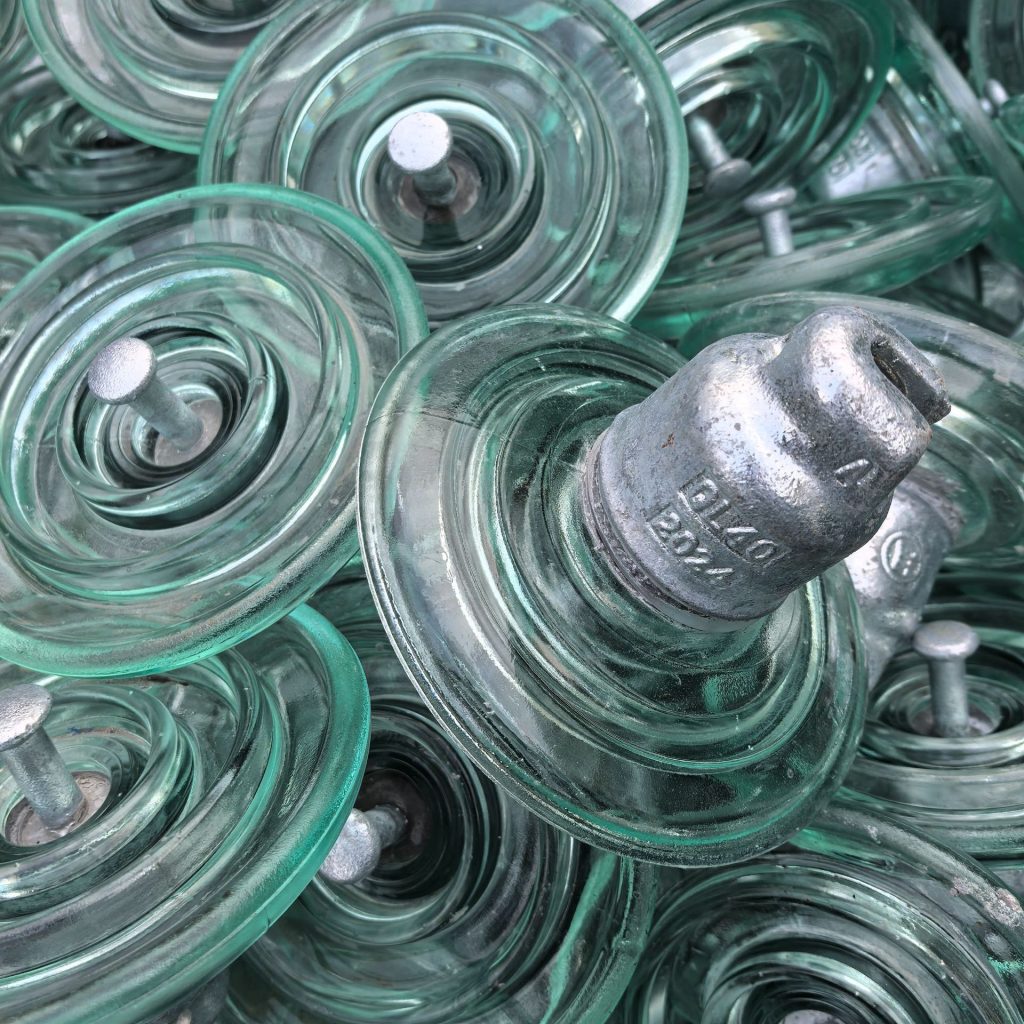
Typical applications
Toughened glass insulators are widely used as:
- Pin and suspension units on overhead lines,
- Insulating supports for substation busings and surge arresters,
- Components in HVDC and HVAC transmission lines where long-term mechanical stability and visual detectability of damage are required.
Key technical advantages
Electrical properties
Glass as a dielectric material offers stable electrical characteristics over long service lives. Carefully controlled glass compositions and glazing deliver high dielectric strength, low leakage currents, and consistent impulse performance — attributes that support dependable operation under transient overvoltages and switching stresses. These stable electrical properties make glass an established choice among glass electrical insulators used across voltage classes.
Mechanical strength and safety
The tempering process gives toughened glass insulators significantly improved mechanical strength compared with annealed glass of the same dimensions. Importantly, the failure mode is unambiguous — shattered or intact — which simplifies inspection protocols and minimizes the risk of undetected internal defects. This predictability is one of the reasons many utilities prefer toughened glass insulator technology for critical line hardware.
Long service life and low aging
Glass does not suffer the same material aging mechanisms as some polymeric insulators (e.g., UV-induced degradation of shed materials). Field studies and long-term assessments demonstrate that high-quality toughened glass insulators can remain in service for decades with limited loss of performance when installed and maintained correctly. This longevity reduces life-cycle costs and simplifies inventory strategies.
Pollution performance and maintenance
While surface contamination can affect any exposed insulator, the smooth, non-porous surface of glass sheds contaminants more readily than many ceramic or polymer surfaces. For polluted environments, manufacturers may apply RTV coatings or specify hydrophobic coatings to extend service intervals; such solutions have been studied and applied successfully on toughened glass designs. The combination of glass surface properties and appropriate profile design helps limit pollution flashovers for glass power line insulators and other outdoor hardware.
Standards and testing that govern glass insulators
The design, type testing, and acceptance criteria for glass insulators used on overhead lines and in substations are covered by international standards such as IEC 60383 (insulators for overhead lines) and related IEC technical specifications for polluted environments. Compliance with these standards ensures predictable mechanical, thermal-shock, and electrical performance across operating conditions and is a must when specifying insulators for transmission and distribution networks.
When procuring toughened glass insulators, request manufacturer test certificates demonstrating:
- Mechanical load and impact tests,
- Thermal shock and temperature cycling results,
- Impulse and power-frequency dielectric tests,
- Manufacturing quality control documentation.
Adhering to these standards helps reduce field failures and aligns procurement with regulatory and utility acceptance practices.
Toughened glass insulator vs. porcelain vs. composite: choosing by use-case
Comparative overview
- Toughened glass insulators: Known for stable dielectric performance, clear visual failure mode, and decades-long service life. Often preferred where inspection regimes rely on visible defect detection and where material aging must be minimized.
- Porcelain insulators: Offer high mechanical strength and have a long track record; however, glazing damage or hairline cracks can be harder to detect visually and may allow moisture ingress in some cases.
- Composite (polymeric) insulators: Lighter and often hydrophobic, offering excellent pollution performance when the silicone sheds remain intact. Composite designs have matured significantly, but their long-term field track record is still a key procurement consideration in some utilities.
Which to choose?
The selection should be based on a combination of:
- Environmental pollution level (IEC 60815 guidance),
- Mechanical loading and conductor tensions,
- Inspection and maintenance strategy,
- Specific reliability targets for the asset (e.g., backbone transmission vs. rural distribution).
For many transmission and critical substation applications, the toughened glass insulator is selected because it offers an optimal blend of durability, inspectability, and predictable behaviour under extreme events.
Design, specification, and procurement recommendations
Specification checklist
When writing product specifications or evaluating supplier proposals, include:
- Reference to applicable IEC/EN standards (for example, IEC 60383 series and IEC TS 60815 guidance on polluted conditions).
- Material and tempering process details — request process descriptions and QC steps for the tempering furnace and cooling profile.
- Type testing evidence — full impulse, mechanical, thermal-shock, and aging-related tests.
- Coating or RTV treatment (if required for severe pollution regions) with field-study or lab evidence.
- Traceability and batch testing — ensure each batch has traceable test reports and serial identifiers for quality control.
Installation and handling best practices
- Keep handling impacts minimal during transport and stringing operations; although glass is toughened, severe localized impacts can still cause damage.
- Torque and mounting instructions from the manufacturer should be followed precisely to avoid stress concentrations.
- Establish visual inspection intervals and record photographic evidence; broken glass is easy to spot, supporting proactive replacement.
- In polluted coastal or industrial areas, adopt cleaning or hydrophobic coating schedules consistent with IEC guidance.
Field experience and lifecycle considerations
Field studies and assessments of toughened glass insulators removed after decades of service document low degradation rates and confirm that when installed per standards, these insulators can achieve very long service lives. Utilities that adopt toughened glass insulators report benefits in reduced unplanned outages and simplified inspection protocols because failed units present clear visual cues. These lifecycle advantages should be quantified in procurement evaluations as total cost of ownership (TCO) rather than upfront unit price alone.
Further reading and reputable references
For engineers and procurement teams wanting authoritative technical detail, consult the following sources:
- Sediver technical notes and catalogues on toughened glass insulators and coatings.
- IEC standards (for example, IEC 60383-1 and companion IEC guidance on polluted environments) — essential for selection and acceptance testing.
Conclusion
A toughened glass insulator remains a practical, proven solution for applications where dielectric stability, predictable failure behaviour, and long-term reliability are priorities. Whether used as glass power line insulators on long transmission strings or as glass electrical insulators supporting substation hardware, their combination of material properties and compliance with international standards makes them a compelling choice for many utilities.