
What is a Drop-Out Fuse Cutout?
A drop-out fuse cutout (often called a dropout fuse or fuse cutout) is a pole-mounted protective device used on overhead distribution lines.
It houses a fusible element inside an insulator body and provides visible isolation when the fuse operates.
This simple, visible action helps field crews quickly locate and replace blown fuses, speeding restoration.
Why utilities still choose drop-out fuse cutouts
Drop-out fuses are low-cost, easy to service, and highly effective for radial feeders and transformer protection.
They provide a clear visual indication of operation and are simple to coordinate with downstream protection.
For many networks the balance of upfront cost, ease-of-maintenance and proven reliability favors cutouts.
How a 33kV drop-out fuse works in the field
When fault current exceeds the fuse-link rating the fusible element melts and the fuse carrier drops away.
The dropped carrier creates a visible open circuit and extinguishes arcing, isolating the faulted section safely.
Correct time-current coordination ensures only the nearest protective device clears, limiting outage scope.
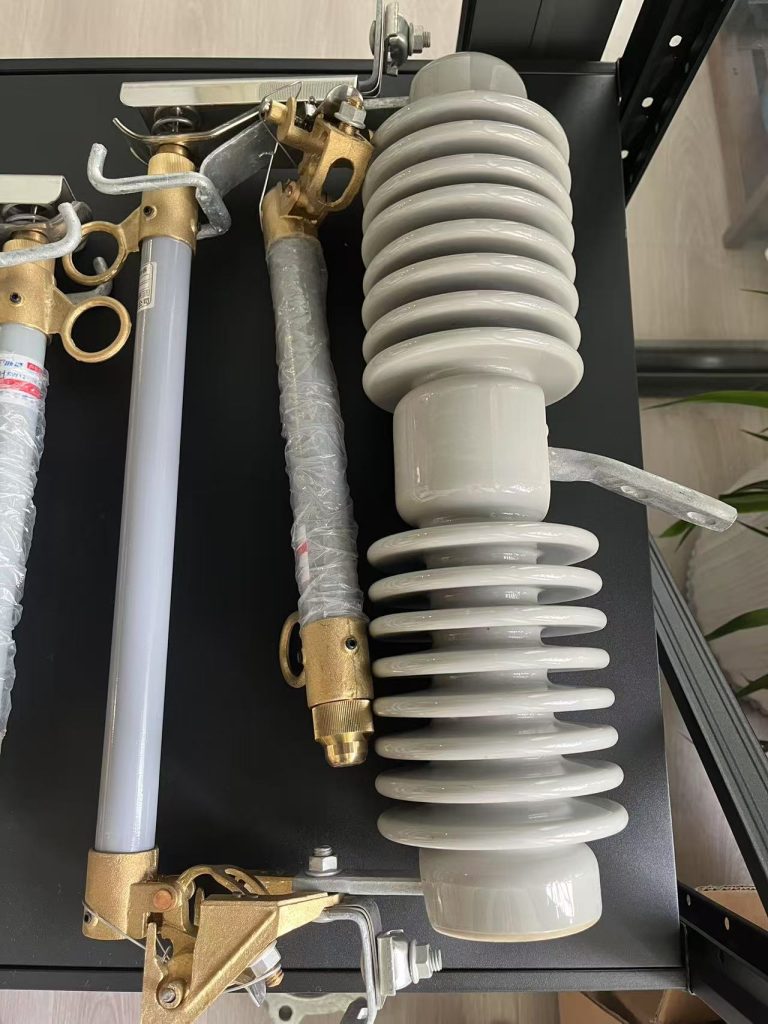
33kV drop out fuse specification — key electrical items to demand
Specify rated voltage (33kV nominal) plus power-frequency and lightning impulse withstand values.
List continuous current ranges, prospective fault current, and the required breaking capacity in procurement docs.
Require full time-current curves, melting characteristics and recommended coordination tables from the supplier.
Mechanical & environmental specifications that matter
State mounting dimensions, carrier type compatibility, drop distance and mechanical strength requirements.
Insulation creepage distance, pollution class and UV/hydrophobic performance are vital in harsh climates.
Ask for material details (porcelain vs polymer body, stainless hardware) and anti-vandal features where needed.
Selecting the right drop out fuse 33kv for different applications
Rural distribution: prioritize robustness, wide time-current tolerances and simple field replaceability.
Urban/industrial feeders: require higher breaking capacity and tighter coordination for elevated fault levels.
Coastal or polluted areas: prefer higher creepage distance, hydrophobic polymer housings and corrosion-resistant fittings.
Drop out fuse 33kv — variants and fuse-link types
Expulsion-style fuse-links are common and economical for many distribution networks.
Current-limiting or arcing-chamber fuse-links reduce equipment stress in high-fault or networked systems.
Ensure interchangeability between carrier assemblies and a clear marking system for fuse ratings.
Common pain points buyers encounter
Mismatched T-C curves causing coordination failures and repeated nuisance trips is a frequent issue.
Purchasing cheap, uncertified fuse-links can compromise breaking ability and risk downstream equipment.
Non-standard carriers or mounting differences force large spare inventories and complicate emergency repairs.
Installation and operational best practices
Follow supplier torque, alignment and clearance instructions to prevent premature mechanical failure.
Avoid locations prone to bird-nests, tree overhangs or debris accumulation that raise flashover risk.
Record site coordinates, label positions and keep single-line diagrams handy to speed field operations.
Maintenance, inspection and lifecycle planning
Implement routine visual inspections to detect hairline cracks, corrosion or signs of arcing early.
Use trend-based replacement: log failure rates and replace groups before catastrophic aging occurs.
Plan spare kits by region — a small, well-chosen stock of carriers and multiple fuse-ratings beats emergency shipping.
Practical selection checklist (quick)
Confirm 33kV nominal and impulse withstand values; obtain time-current curves.
Verify mechanical mounting compatibility, material specs (porcelain/polymer) and anti-corrosion hardware.
Require vendor coordination support, spares list and field reference installations in similar environments.
Conclusion
A well-specified 33kV drop-out fuse cutout delivers reliable, visible protection when matched to the network’s electrical and environmental conditions.
Insist on complete 33kv drop out fuse specification details: time-current curves, breaking capacity, material and mounting compatibility.
Buy for total cost of ownership — verified type tests, local support, sensible spares and sound installation practices yield the most durable, cost-effective Power line product solution.